Showing posts with label Real Estate Blog. Show all posts

Wednesday, March 20, 2013

WORLD'S MOST EXPENSIVE APARTMENT BUILDING

Inside the world’s most expensive apartment building
By: Julie Zeveloff
Business Insider 13/03/15

London’s One Hyde Park is one of the wealthiest and most secretive residences in the world.

Apartments in the Knightsbridge complex cost more than $11,000 a square foot, nearly three times the typical price of luxury London real estate.

But relatively little is known about the people who own homes there. Of the 76 apartments sold in the 86-unit building, 64 are registered to corporations and just 17 are listed as primary residences, according to Nicholas Shaxson, who wrote a great exposé of the building in this month’s Vanity Fair.

Even so, Shaxson and others have found out who some of One Hyde Park’s owners are. Get to know some of the sheikhs, oligarchs, and global rich who own apartments at the world’s most expensive apartment building.

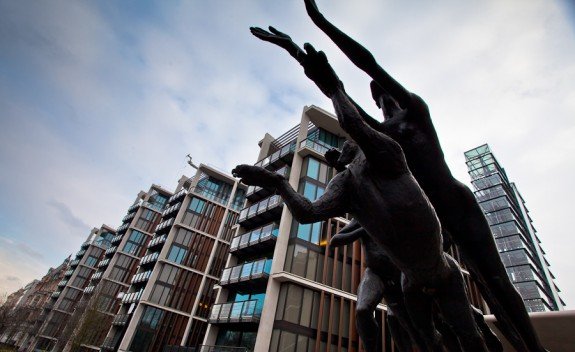
One Hyde Park, located in Knightsbridge, is adjacent to Hyde Park and the Mandarin Oriental hotel.


The per-square-foot price of a unit at One Hyde Park is 10 TIMES the price of average residential real estate in London, and nearly three times more than luxury real estate in the city.


Among other perks, there’s a stainless steel ozone pool, an entertainment suite, a golf simulator, and a spa run by the Mandarin Oriental.


There are also three retailers on site: Rolex, McLaren, and Abu Dhabi Islamic Bank.


Security in the building is insane. There are panic rooms, bulletproof glass, and guards trained by British Special Forces, according to Vanity Fair.


One Hyde Park was created through a joint venture between high-end real estate developers the Candy brothers and Sheikh Hamad bin Jassim bin Jaber Al Thani, the Prime Minister of Qatar.


The owners were some of the first people to buy into the building. The Sheikh paid $64 million for his triplex, which Vanity Fair calls “the best apartment of all.”


Christian Candy reportedly has two apartments that cost $85 million. And Nick Candy owns an 11th-floor duplex penthouse.


In 2010, Ukrainian oligarch Rinat Akhmetov paid $216 million for a penthouse in the complex. It’s the most expensive home ever sold.


Two apartments worth $43.7 million are owned by Professor Wong Wen Young, likely the Taiwanese business tycoon Winston Wong Wen Young.

In April 2011, Australian pop star Kylie Minogue dropped $25 million on a three-bedroom flat in the complex.


Mohammed Saud Sultan al-Qasimi, head of finance for the government of Sharjah, part of the UAE, reportedly paid $18 million for his apartment.


At least one apartment is owned by Russian real-estate tycoon Vladislav Doronin, who is dating supermodel Naomi Campbell.


Nigerian billionaire Folorunsho Alakija is believed to have spent $123 million on several apartments there, all supposedly registered under the name Rose of Sharon.


Vladimir Kim, a copper baron and the wealthiest man in Kazakhstan with a net worth of $2.3 billion, also owns a home there.


And Rory Carvill, an insurance entrepreneur and chairman of U.K. based R.K. Carvill & Co. Ltd. reportedly paid $33.5 million for his residence and additional storage space.


Two apartments held by Irina Viktorovna Kharitonina and Viktor Kharitonin, presumed to be a co-owner of Russia’s largest domestic drugmaker, cost $49.8 million.


Want to live in One Hyde Park? You’re in luck—a 5-bedroom flat there recently came on the market. At $101 million, it’s the most expensive apartment currently for sale in London.

Photos are of apartments currently for sale at One Hyde Park; not actual residences.

Thursday, December 2, 2010

NOVEMBER...WEIGHING IN


It's a tough time to sell a condo
Sales down 38% from a year ago in condo market
By Mario Toneguzzi, Calgary Herald
December 2, 2010 8:00 AM

CALGARY - Calgary's housing market continued to show signs of stagnation in November, with MLS sales down in both the single-family home and condominium markets compared with a year ago.

The last few months have been a tough time to sell a property in the city.

Elizabeth Klein, one of those fortunate sellers in November, was able to sell her condo through Christina Hagerty, a realtor with Re/Max Realty Professionals.

Klein's condo in the Mission neighbourhood was originally listed by another realtor in April. When she re-listed the property with Hagerty at the end of August, the list price was dropped by about 5.7 per cent. It sold for about 3.6 per cent less than the new list price.

"I think we had it priced too high at the beginning," said Klein. "We were going on what the old prices were before the recession kind of kicked in and I think that is why we didn't sell it. And when Christina came along, we decided to lower the price and we were successful. With her it took us a couple of months to sell."

"There's so much on the market. A lot of new ones have come on. People have got a lot more choice," said Klein. "I'm glad that we sold it. Obviously we would have liked to have got more, but I think we were dead on the market. So I think that's why it sold. There's a lot of people out there buying. But I think there's a lot of people sitting on the fence saying OK, maybe prices might come down a wee bit more. I think that's what's happening."

Statistics released Wednesday by the Calgary Real Estate Board indicate single-family MLS sales were off by close to 19 per cent from November 2009, while the average sale price dropped by about two per cent.

In November, there were 891 single-family transactions for an average price of $455,460, while a year ago for the month there were 1,095 sales for an average of $464,444.

In October of this year, there were 888 sales for an average price of $444,744.

The condo market was particularly slow in November with only 310 sales and an average price of $284,667. Sales are down by more than 38 per cent compared with a year ago (504) while the average price has decreased by just over three per cent from $294,264.

In October of this year, there were also 310 condo transactions at an average sale price of $287,793.

"Indeed the second half of 2010 has proven to be weaker than expected and Calgary's housing market is taking some time to regain traction," said Diane Scott, president of CREB.

The month-end inventory for single-family homes for sale was 3,869 compared with 2,658 a year ago, while for condos it was 1,882 compared with 1,434 in November 2009.

Subdued employment growth, especially in the area of full-time jobs, has tempered sales activity, said Richard Cho, senior market analyst in Calgary for Canada Mortgage and Housing Corp.

"The average price has moderated as the housing market continues to favour the buyer. Prices are expected to firm up in the early months of next year as the economy improves, supporting job growth, while active listings decline and move to more balanced levels," Cho said.

Todd Hirsch, senior economist with ATB Financial in Calgary, said the city's housing market is still adjusting to the new realities of the economy.

"While the economy has definitely improved, the housing market has lagged," he said. "There was a notable run-up in activity around a year ago when buyers were anticipating higher mortgage rates. So now, in the second half of 2010, the market of potential buyers is a bit thin. That's weighing down sales and prices."

- - -
Calgary MLS Sales

Category / November 2010 / October 2010 / November 2009
Single-family sales / 891 / 888 / 1095
Single-family average price / $455,460 / $444,744 / $464,444
Condo sales / 310 / 310 / 504
Condo average price / $284,667 / $287,793 / $294,264
Source: Calgary Real Estate Board

Wednesday, November 17, 2010

LOOKING AHEAD TO SPRING 2011


Housing set to find even keel in spring

STEVE LADURANTAYE — REAL ESTATE REPORTER
From Tuesday's Globe and Mail
Published Monday, Nov. 15, 2010

Record low interest rates and a lack of houses on the market have rekindled demand for Canadian real estate, helping to pull the industry out of its sales slump and setting the stage for the most balanced spring market in years.

The Canadian Real Estate Association said Monday that although prices were flat in October and sales slid more than 20 per cent compared with a year earlier, the market posted its third straight month of increased sales.

In a sign of stabilization after two years of wild fluctuations, CREA said October sales were halfway between the lows of December, 2008, and the record high of December, 2009.

Economists said October’s data likely means the market bottomed out in July; while prices won’t rocket to previous highs any time soon, it’s unlikely they have much farther to fall.

“It seems to me the Canadian housing market has been either feast or famine,” said BMO Nesbitt Burns economist Douglas Porter. “But now buyers are facing low rates on one hand, and daily volleys about how bad the market is on the other. That should keep things from getting overly hot, and gives me reason to believe we could have a balanced market in the year ahead.”

After slowing in the recession of 2008, sales activity reached a fevered peak in December, 2009, as buyers rushed back into the market.

Average resale prices peaked at an all-time high $346,881 last May, causing concern that cheap money was driving prices to unsustainable levels. The average resale price in October was $337,842, CREA said.

The market came to an abrupt halt last July, with major regions such as Vancouver and Calgary posting sales drops of nearly 45 per cent and prices pulling back from May’s high. Several factors were cited for the decline: The federal government introduced rules that made it more difficult to qualify for a mortgage, and Ontario and Quebec introduced harmonized sales taxes that made the services associated with buying a home more expensive.

Would-be buyers also faced a barrage of warnings from organizations such as the Bank of Canada, the OECD and International Monetary Fund, all of which have cautioned that as interest rates rise, many Canadians might not be able to make their mortgage payments.

But mortgage rates have actually dropped in the past three months and now sit at all-time lows. A survey by the Canadian Association of Mortgage Professionals released last week showed that Canadians are confident they could shoulder higher mortgage payments without too much difficulty, with 84 per cent saying a $300 monthly increase was no problem.

“There are many reasons to now be optimistic,” said TD Bank senior economist Pascal Gauthier, who called for prices to fall 10 per cent from peak to trough but now expects to issue a more upbeat forecast later this week. “I think there are now limits to both the upside and the downside – things may have firmed up quicker than we expected.”

With the number of houses listed for sale sharply lower than in July, prices are expected to stay firm as buyers compete the few homes available. The months of inventory – the amount of time it would take to sell everything that is for sale, at the current rate of sales – sat at 6.2 months in October, down a full month compared with the July figure.

That doesn’t mean prices are likely to catch fire again in the spring, when activity traditionally accelerates, but it should help keep prices from dropping as buyers and sellers hit the market in equal numbers.

“Affordability drives sales and record low mortgage rates are driving affordability,” said Phil Soper, the chief executive officer of Brookfield Real Estate Services. “I think next year should look a lot like the recent market – with relatively flat prices and fewer overall transactions.”

Photo By: Clara Hinton

BOW WOW


Calgary's The Bow: a new skyline symbol

NATHAN VANDERKLIPPE
CALGARY— From Wednesday's Globe and Mail
Published Tuesday, Nov. 16, 2010
 
More than 200 metres above Calgary’s streets, a crane swings a long metal beam atop the West’s new architectural crown.


The five-tonne length of steel is designed to support the upper reaches of the Bow, a building that is a study in superlatives: the largest building in the Canadian West and the biggest steel project in Canadian history


Kerry Gillis watches the beam move, and shrugs.


“Piece of cake on this job,” says the chief operating officer of Ledcor Construction Ltd., which is building the Bow and has hoisted steel pieces three times as heavy.

Earlier this month, Ledcor finished assembling the building’s steel. The building’s diamond-shaped “diagrid” supports will be completed by year’s end; the walls of glass will be installed by late spring. The Bow, the largest North American construction project outside of New York’s Freedom Tower, will then be externally complete.

There is a certain hubris that comes with building a two-million-square-foot tower that, long before workers had so much as dug the first spadeful of earth for its parking garage, was expected to become the new calling card of Calgary. Even competitors say the Bow is an icon for the city, a glass-covered fist thrust in the face of the recession.

It did not escape the downturn unscathed – financing problems by owner H&R Reit resulted in the suspension of plans for a second building. But construction on the main tower never stopped, and the money issues were eventually resolved with a $425-million financing deal last April.

Now, the building’s upper reaches are taking shape at a time of resurgence for Calgary, which has profited from a new wave of development in the oil sands, driven by sustained strength in crude prices.

As some of the final beams are lifted into place, Mr. Gillis glances across the skyline – or, more properly, down on it, from the lofty heights of what will soon be the new headquarters of Encana Corp. and Cenovus Energy Corp. Several blocks away, crews have pushed another huge new tower, the million-square-foot Eighth Avenue Place, high into the sky. It, too, is a construction monument in a city that is nearing completion on two new landmarks.

But Mr. Gillis scoffs at that tower, too.

“Piece of cake over there. This,” he says, casting a glance around the complicated work of erecting the Bow’s curving structure 58 storeys into the sky, “is real construction.”

The Bow contains 45,000 tonnes of steel connected with 45 tonnes of welding and 800,000 structural bolts, some of them so big they barely fit in a man’s hand. It has 40 elevators and is so tall workers talk about the different climate at its summit. From the ground, its enormous walls of glass – which span an area the size of 14 CFL fields – swallow the sky.

For its builders, all of those attributes have combined to make the Bow Canada’s most prominent billboard – a building that remains on budget, although it may be completed slightly later than expected. It’s a feather in the cap that Ledcor’s most ardent competitors have acknowledged.

“I would call the Bow a signature building in Calgary,” said Roger Dootson, the vice-president and district manager for PCL Construction Management Inc., who also chairs the Alberta Construction Association. “And signature and iconic buildings do help out a company’s résumé for future projects.”

Ledcor has a long history in Alberta. Founded in 1947, it has grown into one of Canada’s largest construction companies, with $2-billion a year in revenue. But in Calgary, the Bow has been a coming-out party of sorts for Ledcor, whose efforts in Western Canada have focused largely on the less-glitzy work of building pipelines and oil sands projects. For Ledcor, the Bow has become something of a marketing exercise for its bread-and-butter business of putting together industrial structures.

Standing on top of the Bow, the reason is obvious. In its nearly-complete shadow stand the head offices of much of corporate Calgary. Suncor Energy Inc. is a next-door neighbour. TransCanada Corp. is so close that Ledcor once received a call from a safety executive at the pipeline company, who had spotted a lapse on site through his office window. The problem was quickly fixed.

Ledcor has toured all of its major corporate clients through the construction site, in hopes of creating a profitable halo effect from the building.

“It’s expertise. They can see that we’re not just a one-line company,” said Bob Scott, the Ledcor senior project director who has led the Bow project.

And there is little denying the scale of the Bow construction effort. Because it was building in the middle of a crowded urban environment, Ledcor had little spare space to work with – and has had to warehouse most of its construction materials at a large offsite yard. The company was obligated to turn delivery timing into an art form.

Another unique aspect: To save time and costs, each of the restrooms in the building was built in Ontario as a fully-finished, fully-furnished unit inside a container. Each container was then shipped, lifted into place and connected to plumbing, ready for use. Even the light bulbs were screwed in several thousand kilometres away.

Ledcor also had to contend with hiring up to 1,250 staff – the Bow’s peak labour requirement – in a province that was, when construction began, suffering from an overheated economy. But it got lucky: The downturn came just as construction ramped up. Suddenly, workers from Fort McMurray became available.

That doesn’t mean the Bow has been Ledcor’s most profitable endeavour.

“These big trophy assets are difficult, and at the end you say, ‘I could have made more money building 10 smaller towers,’ ” said Greg Kwong, regional managing director for CB Richard Ellis in Calgary. “But at the same time, you need these big trophy assets as far as stars on your chest are concerned, to help promote your company.”