Showing posts with label Development. Show all posts

Tuesday, July 15, 2014

BLOSSOMING IN VIC PARK


Proposed downtown condo project will include apple orchard
BY DYLAN ROBERTSON
CALGARY HERALD JULY 15, 2014

Fresh apples will be ripening between two downtown condominium towers as a developer aims to give Calgary a more fruitful and dynamic city centre.

The Orchard on Twelfth is a two-tower project at the southeast corner of 12th Avenue and 5th Street S.E., just northeast of Stampede Park. Lamb Development Corp. of Toronto is planning two 31-storey buildings, which will nestle a one-acre orchard of apple trees between them on a 61,000-square-foot land parcel.

“Not only is this a public and private amenity for the city, but also a true green feature; not a stupid green roof that really in the end doesn’t do much,” said company head Brad Lamb. “It’s a phenomenal thing to have in a city, and it’s going to produce tens of thousands of apples which are going to be eaten.”

The company commissioned an Ipsos Reid survey last month which polled 1,000 Americans and 1,000 Canadians, asking them to guess the location from a digital rendering of the project with its apple orchard. Most Canadians thought the image was in Vancouver or Toronto, placing Calgary seventh out of 13 possibilities; Americans thought of Portland or New York and placed Calgary 12th.

The same poll found that 93 per cent of North Americans — especially younger adults — want greener downtowns, and would welcome projects that delivered food.

“I always try to deliver, if I can, a public amenity that the city will enjoy and the residents will enjoy,” Lamb said, comparing the Orchard on Twelth with another property his corporation is developing, 6th and Tenth, which will include a fountain park. “Our cities aren’t green enough, visually and for taking in C02.”

Richard Cho, senior market analyst with Canada Mortgage and Housing Corp., says the projects are part of an ongoing build up in new Calgary condominiums.

“We had lower inventory and now we see that being made up for,” said Cho. He noted that in last year’s January to June period, construction started for only 1,004 apartments. In the same months this year, the city netted some 4,010 starting units, and Cho says more are anticipated.

Alberta isn’t known for its apple orchards but Lamb said an agricultural firm has chosen tree species that can grow edible fruit in the area. A third party will be paid to prune the trees and harvest the fruit for sale or donation.

But for Lamb, the buildings themselves are more interesting.

“They’re rectangular, simple in design, but they’re super clean and super modern,” he said. “We’re delivering beautiful architecture and affordable apartments; these two buildings are spectacular in their own right.”

Units will range from $249,900 for one-bedroom apartments to over a million dollars for larger units. Lamb says those prices are competitive with Beltline properties. The project will cost $130 million with $170 million in expected revenue, he said.

An older house on the block will be demolished, while buildings on the fifth of the block not owned by Lamb Development will remain in place.

Lamb says his company is currently waiting for a permit, but he expects ground to be broken within the year as no zoning exception is needed. He expects the first phase to open in about three and a half years, followed by the second about five years from now.

Tuesday, August 13, 2013

SHAPING UP


Calgary leads nation in building permit growth

June value up 16.6% from May


CALGARY — Calgary saw the country’s largest increase in June in the total value of building permits, according to Statistics Canada.

The federal agency reported Wednesday that estimated building permit value was $537.7 million for the Calgary region, up 16.6 per cent from May and a year-over-year hike of 36.0 per cent.

“Following a 41.0 per cent decline in May, the value of permits issued in Calgary advanced largely as a result of higher construction intentions for commercial buildings and multi-family dwellings,” it said.

Tom Dixon, business development manager for real estate and logistics with Calgary Economic Development, said there has been an increase in activity recently in the non-residential sector in Calgary.

“The principal factor is there is a very low vacancy rate and there’s low availability in both the industrial portfolio and in downtown office space. The Class A office space in particular is in very short supply,” said Dixon.

According to Statistics Canada, the residential sector in Calgary saw a 3.7 per cent increase in building permits from May to $344.5 million while the non-residential sector was up 49.65 per cent to $193.2 million.

In Alberta, total building permits of $1.4 billion were down 0.4 per cent on a monthly basis but up 24.3 per cent year-over-year.

The residential sector in the province saw a monthly decrease of 10.4 per cent to $757.9 million. However, that was up 15.8 per cent from last year.

The non-residential sector in Alberta jumped to $645.4 million, up 14.7 per cent from May and a hike of 36.1 per cent from June 2012.

Todd Hirsch, chief economist with ATB Financial, said a dip in residential permits in June in Alberta was almost exactly offset by a rise in non-residential permits.

“Residential building in our province has been consistently strong in 2013, so a small pull-back, as occurred in June, is neither unusual or cause for alarm,” he said. “The steady inflow of job-seeking migrants to the province this year has kept the demand for housing at a healthy level.”

He said non-residential building permits are much more volatile month-to-month but in June developers in the province continued to find market opportunities in office buildings, stores and restaurants.

“Building permits are an excellent forward-looking indicator of the actual construction activity that can be expected in the coming months,” added Hirsch. “The overall message . . . is that Alberta’s construction sector remains in excellent shape.”

Across Canada, contractors took out building permits worth $6.6 billion in June, down 10.3 per cent from May and the first decrease in six months. It was also off 4.8 per cent from June 2012.

After three consecutive monthly increases, the total value of permits in the residential sector declined 12.9 per cent to $4.0 billion in June. That was also down 10.8 per cent from a year ago.

In the non-residential sector, the total value of building permits decreased 6.1 per cent to $2.7 billion in June. But that was up 5.8 per cent from last year.

Friday, June 29, 2012

SMART GROWTH IN CENTRE


Infographic: Nature of Calgary neighbourhoods changing, new census results reveal
 'Smart growth' emerges in city centre
By Jason Markusoff,
Calgary Herald June 29, 2012

Although the 2012 census shows the same story on all Calgary's suburban edges - grow, grow, grow - a blend of dynamics are reshaping the city's existing neighbourhoods.

In older, inner-city neighbourhoods such as the Beltline, Chinatown and Inglewood, new condo projects are spiking community populations. In the past year, 42 per cent of new homes have sprung up within the built-up part of Calgary - the sort of redevelopment pattern Calgary's "smart growth" blueprints urge.


"If we're maximizing the infrastructure we've already built, that helps accommodate the growth and put less pressure on the edges," said Rollin Stanley, the city's new general manager of planning.

In other communities like Parkdale and Spruce Cliff, population growth is being triggered by some densification, but more so by an influx of new families moving into homes that empty nesters have vacated.

Bowness, which has in the past been marred by population decline, gained 312 residents last year but only five dwelling units.

"Those houses will turn over. We have to track very closely how this changes," Stanley said, recalling in his former neighbourhood in Washington's suburbs, five houses occupied by octogenarians flipped to families with kids, a trend that would put new pressure on once-lagging schools.

The flip side of the Calgary trend is the population decline of communities in a middle ring of Calgary suburbia. Deer Run, Sundance, Scenic Acres, Edgemont and MacEwan all share two things in common: they have lost a sizable chunk of their population in the last four years, and were all developed between 1978 and 1982. A similar generational dip has previously hit communities of a different vintage.

Photo By: John Ostrom

Friday, April 27, 2012

TO BE GREEN WITH ENVY


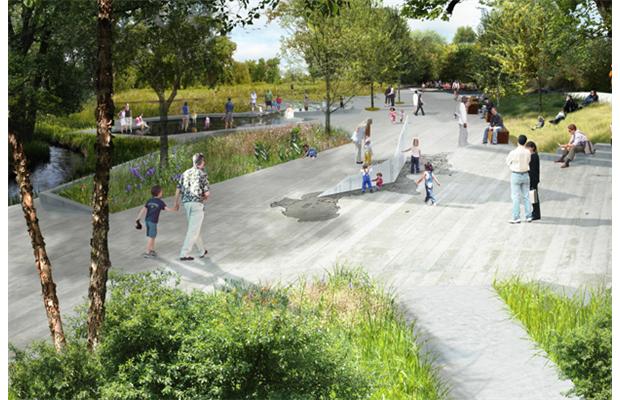
'Urban oasis' slated for St. Patrick's Island
Development plan includes boardwalks, $25M bridge
By Jason Markusoff
Calgary Herald April 26, 2012

Overgrown with weedy brush and nothing inviting beyond a few metal benches and cracked pathways, St. Patrick's Island has long been the ugly sibling of the Calgary Zoo's St. George's Island and the festival-friendly Prince's Island.

Its Cinderella conversion will come at the hands of the redevelopment agency that controls East Village, and will follow a similar pattern of the nearby RiverWalk: clear it out, spruce it up and watch 'em come.

Landscape architects from Denver and New York were announced Wednesday to convert a haven for rough sleepers and drug dealers into a paradise of boardwalks, food concessions, skating and family picnics.

"We're quite confident we can create a place where people and kids can safely touch the river, put their toes in the water," said Mark Johnson of Colorado-based Civitas. "So that you can have the kind of adventure play you get in the mountains right in the core of the city."

Although the redesign is aimed at maintaining a natural feel on the island, the big first step will be razing invasive species of shrubbery and trees that have provided cover for the sleeping homeless.

It will have better "visual access" and much better lighting, Johnson said.

"Being on an island comes with the connotation that you're getting away a little bit - that you're not in the heart of things, that you're a little isolated and that's special," Johnson said.

"Well, today, as soon as the leaves come out, you cross the bridge and you get on the island, you don't realize you're on an island, because you're enclosed in the woods. So we'd like to do some opening."

Civitas has overhauled a riverside stretch in Denver while partner W Architecture of New York did the same with part of Harlem along the East River.

But the head of Calgary Municipal Land Corp. said the redesign will do more than take cues from nature.

"One of the key pieces of feedback we got from Calgarians is don't overlandscape the setting. Yes, we want it to be attractive and we want to pull people down to it, but we still want it to feel like it's an urban oasis," Michael Brown said.

A lagoon will be restored between St. Patrick's and St. George's islands, for wading and winter skating. Next to it will be an amphitheatre for a couple of hundred spectators, as well as food concessions.

An open event space will mark the centre of the island, and its west tip will be crowned by a $25million pedestrian bridge connecting to both Memorial Drive and East Village.

It will be built by Graham Construction - the same firm that delivered the Peace Bridge nearly 11/2 years behind schedule.

However, a different team within the Calgary-based infrastructure giant will deliver this unnamed bridge, a simpler double-arch crossing designed by French firm RFR.

"Not as complicated for the construction, no," said Bill Campbell, Graham's operations manager on this project as well as the on-time, onbudget 4th Street S.E. underpass.

The bridge and island will be funded through the same "revitalization levy" loan that will be recouped through property taxes by new development in East Village and the downtown's east end, including The Bow office tower.

Brown said the island will find its "niche" by welcoming smaller festivals than could fill Prince's Island, which was named one of the top 10 public spaces in Canada last year by Spacing magazine.

The architects of St. Patrick's Island have an opportunity that didn't exist with Prince's Island - to reinvent the whole thing all at once.

The downtown's largest park space was redesigned in stages - first in the 1960s, and then again in the 1990s, with the addition of the eastern wetlands and a massive stage.

Large chunks of Prince's Island's northern side remain naturally rugged, and offer few clear vistas of the Bow River for park-goers.

"A lot has changed when it comes to incorporating natural areas and park design," Ald. Druh Farrell said.

Ald. Gian-Carlo Carra said the addition of an eatery like another River Cafe would create a "sense of ownership" on the island.

"Public spaces need mayors, whether it's the guys who run the kiosk or people who have a legitimate commercial reason to be there to ensure that a space is well kept up and makes sure that the bad guys don't set up shop," he said.

A restaurant is also a key feature of the revamped Central Memorial Park.

KEY PROPOSALS

- Amphitheatre for a couple of hundred spectators
- Food concessions
- $25-million pedestrian bridge linking both East Village and Memorial Drive
- New bike pathways
- Nature trails and boardwalks
- Restored lagoon for skating and wading between St. Patrick's and St. George's islands
- Kayak/raft launch