Friday, April 12, 2013

A TEXTBOOK MARKET?


What happened to the expected Alberta real estate boom?
Market influencers tempering demand
By Mario Toneguzzi
Calgary Herald April 11, 2013

CALGARY — Several ‘market influencers’ have kept the reins on the expected Alberta real estate boom, says a new report on the housing market.

The report, by Don Campbell, senior analyst and founding partner of the Real Estate Investment Network, said debate is raging about why the market isn’t booming like it did in 2006 and 2007 when the job market and population in the province were growing at the same rates as they are today.

“The real difference this time is hidden in the strong forces of today’s market influencers. It is very true that the market drivers are all in place to support a large growth in housing purchase demand and price increases, in fact it is a textbook market for a boom,” said Campbell.

“In Alberta, the GDP and job growth have driven very strong population growth which has led to low vacancy rates not experienced in this province for many years. Street rents are jumping due to the rental supply/demand inequality. So, on the surface that means Alberta should be experiencing another one of those unsustainable booms. Well why isn’t it? And is there one still in the works?”

He said certain wild cards can throw a market off its prescribed cycle for periods of time.

“So, despite all of the market drivers being in place to push the Alberta real estate market into its next boom cycle the market continues to underperform its economics. Why? Simply, there are market influencers in play and that is why we are not yet seeing the expected rush into the market demand,” he said.

They include the once-bitten, twice-shy attitude equating into a local lack of confidence in the market. Many Albertans made their first home purchases during the previous boom. They were hit hard when the financial crash came. This has tempered enthusiasm for the market now.

Tighter mortgage qualification rules have also tempered market demand.

Overall consumer confidence in real estate is taking a hit with many recent reports and headlines on the state of the Canadian market saying it may be over-priced or overvalued.

A large portion of Alberta population growth is from two key demographics who are less likely to buy a house immediately — immigrants and ‘Echo-boomers’.

According to the Calgary Real Estate Board, total MLS sales year-to-date in the city until April 10 were 5,798 transactions, up 3.72 per cent compared with the same period last year.

The average sale price this year has risen by 8.08 per cent to $451,246 while the median price is up by 5.92 per cent to $397,000.

Ann-Marie Lurie, CREB’s chief economist, said the organization never felt the economy was about to boom, based on several factors.

“The first consideration is the economy,” she said. “In the 2005-2007 period, we had significant growth in both the oil and natural gas sector, economic growth as of late has only been driven by the oil sector. While this has helped support growth, there have been some challenges regarding bottlenecks and price discounts which has impacted employment growth prospects in the province. We also shouldn’t forget that the natural gas market continues to struggle. Our economic growth is progressing but at a slower pace, and forecasters also estimated that employment growth and net migration would ease this year, two factors pointing towards slower demand growth in housing.

“The next consideration is fundamentals in the housing market. Inventory levels were generally more elevated in the resale market, and it has taken some time to absorb some of the excess in the market. While this has occurred primarily in the single-family market, it has only started to spillover into the surrounding areas, the condominium market, and the new home market. When considering all the options available to consumers, there was sufficient choice to prevent any significant shortage in the entire housing market, which was the case in 2006-2007, causing a unsustainable jump in home prices.”

She said she is not surprised that the market didn’t boom, given the economic backdrop and current supply in the market.

Lai Sing Louie, regional economist for the Prairies and Territories for Canada Mortgage and Housing Corp., said market conditions in Alberta’s housing markets today are different from the boom.

“Some of the differences include higher household debt as well as more prudent lending conditions today. Also, some of the transactions in that period were investor driven and we have not experienced that to the same extent today,” he said.

The underlying economics and Market Drivers state that the market should be on fire, just like it was back in 2006 and 2007 – that is unless you begin to factor in these influencers, said Campbell.

“Let us make sure we are analyzing today’s markets with today’s conditions and not compare them to previous boom-bust cycles. Each cycle has its own influencers that either heat up or cool down a market and this current cycle from 2006 until today is the perfect proof of that,” he said.

“As long as the drivers are strong, the market is structurally strong, no matter what the influencers are doing. The concern should arise when the drivers are weak and the influencers are pushing the market upwards with no support. That is not what is happening in Alberta right now; in fact, the drivers remain strong despite the headlines.”

Ben Brunnen, chief economist with the Calgary Chamber of Commerce, said the province is definitely seeing all of the signs of strong economic and potentially housing growth.

“Net inter-provincial migration, population growth is up. Unemployment is low and GDP growth is relatively high,” said Brunnen. “I think we’re seeing probably a bit more of a cautious consumer out there. I do think we’ll see some strong real estate activity happening in Calgary but not like in the boom.

“I think there continues to be some caution in the market for a number of reasons. While Alberta’s economy is good, the global economy continues to be shaky, especially Europe and the United States. So people don’t have that strong confidence per se that this economic activity is going to be sufficiently robust that they should buy a house.”

CHECK OUT THESE PIPES!


Canada new housing prices up 0.2 percent on strength in Calgary
Reporting by David Ljunggren; Editing by Theodore d'Afflisio
Thu Apr 11, 2013

OTTAWA (Reuters) - New home prices in Canada rose by 0.2 percent in February, the 23rd consecutive month-on-month increase, pushed up by a buoyant market in the western city of Calgary, Statistics Canada said on Thursday.

The advance matched analysts' expectations. Calgary prices rose 1.0 percent from January - the largest month-over-month increase since May 2007 - on higher material and labor costs. Calgary is the center of Canada's booming energy industry.

Overall, prices rose in 10 cities, stayed unchanged in nine and fell in two. On a year-over-year basis new housing prices in Canada rose by 2.1 percent in February, down from 2.2 percent in January.

The Canadian government, which imposed tighter mortgage rules last July, and the Bank of Canada have long expressed concerns the housing market might overheat.

The new housing price index excludes condominiums, which the government says are a particular cause for concern.

Photo by: Leo Reynolds

Friday, April 5, 2013

WITHIN A HAIR


Resale home prices rise to near record
By Claire Young
Calgary Herald April 5, 2013

Fewer houses for sale and greater demand are pushing single-family resale housing prices up to near historical averages, says the Calgary Real Estate Board.

The average price rose to $518,392 in March, up 9.6 per cent from $472,698 during the same month last year.

This is within a hair of the new record of $518,500 for the average resale price for single-family homes logged in February, which beat the old high mark of $506,700 set in July 2007.

“Tighter rental conditions and continued employment growth has supported housing demand growth,” says chief economist Ann-Marie Lurie of CREB. “However, for those looking for more affordable single family home products, their choices continue to narrow.”

There were 3,194 new resale listings in Calgary in March, down almost five per cent compared to 3,348 during the same time last year.

For the first three months of 2013, the number of new listings was 8,358, down 4.6 per cent from 8,761.

“Less resale product available to consumers is ultimately limiting sales growth,” says CREB president Becky Walters in a news release. “In addition, resale homes are selling in less time and with continued upward pressure on prices.”

Listings of single-family resale homes in Calgary saw a year-over-year drop, declining to 2,239 in March, down 4.5 per cent from 2,346.

March’s benchmark price —that of a typical home based on a formula that uses various factors to ensure accurate comparisons — also rose to $446,500 in March, up 8.9 per cent from $411,000.

New listings of single-family homes under $500,000 are declining at double-digit rates, says Lurie. She predicts this will drive potential Calgary homebuyers to consider surrounding towns, condominiums or the new home market.

In Calgary, total sales of single-family homes dropped to 1,480 in March, down six per cent from 1,575.

The board’s Zone A, which is roughly the city’s northwest, saw 541 transactions at an average sale of $507,545 and 33 days on the market.

The two communities in the city that saw the most sales activity in March were both in Zone D, in the southeast.

Cranston and McKenzie Towne both logged 41 sales. The highest average sales were logged in the board’s Zone C in the southwest community of The Slopes, with two sales averaging $1.72 million.

OUT-OF-TOWN SALES DROP

Total MLS sales of resale homes in the communities surrounding Calgary dropped by two per cent in March compared to the same month last year, says the Calgary Real Estate Board.

Sales fell to 364, down from 372 sales, while new listings dropped significantly during this time to 662 in March, down 15.6 per cent from 785 last year.

But average prices rose to $365,002 in March, up 4.7 per cent from $348,474, says the board — and benchmark prices also increased to $336,100, up 7.1 per cent from $348,474.

The benchmark price is that of a typical home determined using various factors to ensure accurate comparisons.

Monday, April 1, 2013

Calgary resale housing market seeing price growth

One of few in Canada with more than 7% hike

By Mario Toneguzzi, Calgary Herald March 28, 2013

CALGARY — Calgary is one of only a handful of markets across Canada that has seen seven per cent and more year-over-year price growth for residential real estate, according to the Conference Board of Canada.

In a resale housing survey of markets across the country for February, released Thursday, the board said the city, along with Regina, Saskatoon, Thunder Bay, Halifax and Newfoundland, experienced year-over-year price growth of seven per cent or more for the latest three months.

On a seasonally-adjusted annual rate, sales in Calgary of 25,416 are up 2.0 per cent in February from last year while listings have dropped by 5.1 per cent to 40,308.

The average sale price in Calgary was $438,412, up 6.1 per cent from February 2012.

Wednesday, March 20, 2013

OUT-PERFORMING IN AB


Calgary listed as an “out-performer” in Canadian real estate market
Pace predicted to be moderately lower for Canada
By Mario Toneguzzi
Calgary Herald March 11, 2013

CALGARY — Canada is expected to embark on a gradual, modest, downward housing market adjustment over the next three years with a “measly” two per cent annual price gain over the next decade, says a study released Monday by TD Economics.

But the bank has also listed Calgary as an “out-performer” in Canada for the long-run rate of return on Canadian real estate. Compared with the national picture, Edmonton, Vancouver, Victoria and Toronto were also listed as out-performers for the future.

“With the slowdown in the Canadian housing market well entrenched, many are worried about the future value of their homes. This is not surprising as real estate is the largest financial asset most Canadians have in their possession,” said TD Economics.

“The housing market is prone to cyclical ups and downs and we should embark on a gradual, modest, downward adjustment over the next three years. We project a 3.5 per cent annual rate of return on real estate to prevail beyond 2015 – this is the long-run rate of increase for home prices in Canada. However, this pace will be moderately lower than they have been historically (5.4 per cent).”

Derek Burleton, vice-president and deputy chief economist with TD Economics, said Calgary had a run-up in prices before the recession and then a sharp decline during the recession.

“I guess prices didn’t come back too much but certainly sales fell back and now you’re getting a bit of a cyclical bounce,” he said, adding a long-term forecast takes into account key economic drivers like population growth and the potential of the economy to generate income.

“Based on some of the key drivers of growth, Calgary ranks right up there at the top and that should stand the housing market good stead. At least continue to drive above average price gains over the long run.”

The average MLS sale price in Calgary was $180,420 in 2000. That climbed to a peak of $423,770 in 2007 before dipping to $394,064 in 2009. From then, it has steadily climbed, reaching an all-time record of $428,644 in 2012.

Becky Walters, president of the Calgary Real Estate Board, said the Calgary market is really strong this year due to the in-migration it has been getting over the past 12 months.

“It’s not maybe as strong this year as it was last year but it’s certainly strong,” said Walters. “We’re seeing a nice steady growth. We’re seeing prices starting to come up a little bit not tons.”

For example, according to CREB, year-to-date until March 10, there have been 3,595 MLS sales in the city, up 4.66 per cent from the same period a year ago, and the average sale price has jumped by 9.23 per cent to $451,189.

However, at the national level, TD said a string of lacklustre performances over the next few years will mean that the annual rate of return for real estate in nominal terms will be a “measly” two per cent over the next decade, meaning home price gains should simply match the pace of inflation.

“Our research at REIN Canada is showing that for the coming five years, outperforming markets will be those based not in speculation or foreign investment, they will be those markets supported by underlying economics,” said Don Campbell, senior analyst and founding partner of the Real Estate Investment Network. “The Canadian real estate market is too broad and too diverse to paint with one story or byline and will become an increasingly regional story. Supporting economics such as increasing jobs, increasing population through migration — especially those areas which are attracting a younger, working age cohort — and increasing incomes will play a larger role in market demand and value than it has in the last five years.

“Despite Calgary and Edmonton’s value moves already experienced, they are both rated in the most affordable major centres in the country because average incomes are also higher than in most other regions. This, along with the younger age of in-migrants to these cities from other parts of the country, will be strong and supporting factors for these market for the coming years.”

Richard Cho, senior market analyst in Calgary for Canada Mortgage and Housing Corp., said in the Calgary region the average price in 2013 is expected to reach $423,000, up 2.6 per cent from 2012.

“The rate of growth is anticipated to be higher here than in many other areas of the country as the average resale price in Canada is forecast to increase by only one per cent in 2013,” he said. “Supply of homes in Calgary’s resale market has come down from a year earlier while sales have been fairly stable. The resale price in 2014 is forecast to continuing rising in Calgary, averaging $434,000.”

WORLD'S MOST EXPENSIVE APARTMENT BUILDING

Inside the world’s most expensive apartment building
By: Julie Zeveloff
Business Insider 13/03/15

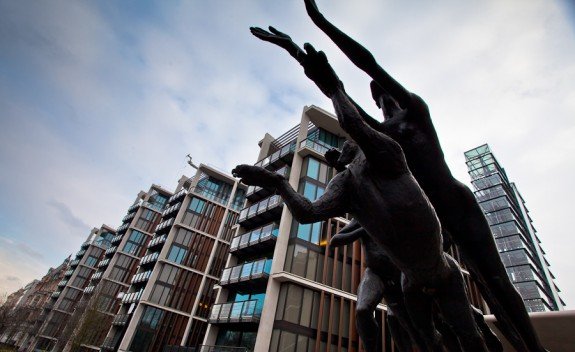
London’s One Hyde Park is one of the wealthiest and most secretive residences in the world.

Apartments in the Knightsbridge complex cost more than $11,000 a square foot, nearly three times the typical price of luxury London real estate.

But relatively little is known about the people who own homes there. Of the 76 apartments sold in the 86-unit building, 64 are registered to corporations and just 17 are listed as primary residences, according to Nicholas Shaxson, who wrote a great exposé of the building in this month’s Vanity Fair.

Even so, Shaxson and others have found out who some of One Hyde Park’s owners are. Get to know some of the sheikhs, oligarchs, and global rich who own apartments at the world’s most expensive apartment building.

One Hyde Park, located in Knightsbridge, is adjacent to Hyde Park and the Mandarin Oriental hotel.


The per-square-foot price of a unit at One Hyde Park is 10 TIMES the price of average residential real estate in London, and nearly three times more than luxury real estate in the city.


Among other perks, there’s a stainless steel ozone pool, an entertainment suite, a golf simulator, and a spa run by the Mandarin Oriental.


There are also three retailers on site: Rolex, McLaren, and Abu Dhabi Islamic Bank.


Security in the building is insane. There are panic rooms, bulletproof glass, and guards trained by British Special Forces, according to Vanity Fair.


One Hyde Park was created through a joint venture between high-end real estate developers the Candy brothers and Sheikh Hamad bin Jassim bin Jaber Al Thani, the Prime Minister of Qatar.


The owners were some of the first people to buy into the building. The Sheikh paid $64 million for his triplex, which Vanity Fair calls “the best apartment of all.”


Christian Candy reportedly has two apartments that cost $85 million. And Nick Candy owns an 11th-floor duplex penthouse.


In 2010, Ukrainian oligarch Rinat Akhmetov paid $216 million for a penthouse in the complex. It’s the most expensive home ever sold.


Two apartments worth $43.7 million are owned by Professor Wong Wen Young, likely the Taiwanese business tycoon Winston Wong Wen Young.


In April 2011, Australian pop star Kylie Minogue dropped $25 million on a three-bedroom flat in the complex.


Mohammed Saud Sultan al-Qasimi, head of finance for the government of Sharjah, part of the UAE, reportedly paid $18 million for his apartment.


At least one apartment is owned by Russian real-estate tycoon Vladislav Doronin, who is dating supermodel Naomi Campbell.


Nigerian billionaire Folorunsho Alakija is believed to have spent $123 million on several apartments there, all supposedly registered under the name Rose of Sharon.


Vladimir Kim, a copper baron and the wealthiest man in Kazakhstan with a net worth of $2.3 billion, also owns a home there.


And Rory Carvill, an insurance entrepreneur and chairman of U.K. based R.K. Carvill & Co. Ltd. reportedly paid $33.5 million for his residence and additional storage space.


Two apartments held by Irina Viktorovna Kharitonina and Viktor Kharitonin, presumed to be a co-owner of Russia’s largest domestic drugmaker, cost $49.8 million.


Want to live in One Hyde Park? You’re in luck—a 5-bedroom flat there recently came on the market. At $101 million, it’s the most expensive apartment currently for sale in London.

Photos are of apartments currently for sale at One Hyde Park; not actual residences.

BOOM BOOM POW

Alberta economy continuing its 'impressive boom'
By Mario Toneguzzi
Calgary Herald March 19, 2013

CALGARY — Any dark clouds that are currently hanging over Alberta will clear by 2014, paving the way for strong business and consumer activity, says a report by RBC Economics.

The bank’s latest Provincial Outlook, released Tuesday, said the province’s economy will continue its “impressive boom” through 2013, after leading the country’s economic growth in 2012, despite facing challenges.

RBC forecasts a provincial real GDP growth rate of three per cent due to strong crude oil production as well as high levels of capital investment, employment and population growth. This will be second in the country behind the 5.1 per cent growth expected in Newfoundland & Labrador.

RBC is predicting Alberta will lead the country in economic growth of 4.2 per cent in 2014.

In December, RBC forecast growth of 3.5 per cent this year for the province. The forecast for 2014 has remained the same.

“Even though the province recently announced a $2 billion budget deficit, Alberta is unquestionably in the midst of an impressive economic boom – particularly with capital investment fuelling manufacturing and wholesalers’ sales. Attractive employment opportunities are also bringing new migrants to the province, boosting population growth and in turn, consumer spending,” said Craig Wright, senior vice-president and chief economist at RBC. “As the economy continues to thrive across the majority of key industries, Alberta will remain at the top-end of Canada’s economic growth rankings this year.”

Economic growth in the province in 2011 was 5.1 per cent followed by 3.5 per cent last year.

Todd Hirsch, senior economist with ATB Financial, said Alberta’s economy is moderating somewhat.

“So I think we will see probably a slower year for growth than what we saw in 2011 or 2012,” said Hirsch. “A lot of that of course prompted by those softer energy prices and maybe a little bit of pullback by the provincial government. But I think we’re still going to see kind of a nice moderate healthy level of growth of around 2.5 to three per cent.

“Going forward beyond that it gets trickier and we don’t really do forecasts beyond 2013 but I would still see 2014 as a pretty good year ... It’s not going to feel quite like the boom years of 2006, 2007 either. We’re just going to have nice healthy moderate growth.”

RBC said there are a few weak spots in Alberta’s economic outlook. Investment intentions in the oil and gas sector are essentially flat for 2013. RBC said Alberta’s energy developers’ plans are being weighed down by rapidly rising energy production in the U.S., pipeline bottlenecks and the ‘bitumen bubble’, all of which contributed to lower crude oil prices in Canada relative to global benchmarks late in 2012.

“Weaker than expected oil prices put a multibillion dollar hole in Alberta government’s revenues, and led to a 2013 provincial budget that detailed renewed public sector spending restraint,” said Wright. “Still, any pullback in capital spending will be short-lived as pipeline issues are addressed and crude oil price relationships normalize.”

RBC trimmed its real GDP growth forecast for Canada to 1.8 per cent through 2013, following softer-than-expected growth in 2012. For 2014, it is forecasting 2.9 per cent growth across the country. In December, it forecast growth of 2.4 per cent this year and 2.8 per cent in 2014.

“After boasting a relatively strong economic performance over the past several years, Canada’s economy hit a speed bump in late 2012,” said Wright. “That said, financial conditions continue to support growth. As confidence recovers, business spending should accelerate, albeit at a less rapid pace than we saw in the early days of expansion.”